QBR deckMeetingFri5 pm
Read as the date: 5pmfri → Fri, Oct 16
Type the date into the title
The title field reads days, dates and times out of what you type and leaves the rest as the name. Try anything.
In the planner, N opens this box.
Paste the brief. Every meeting, deadline, deliverable and milestone from every project, as an agenda for the week and a roadmap for the quarter.
No card to start. Reads PDF, Word or pasted text. Export any time.
Reads what they actually sent you. The text comes out of the file on your own device.
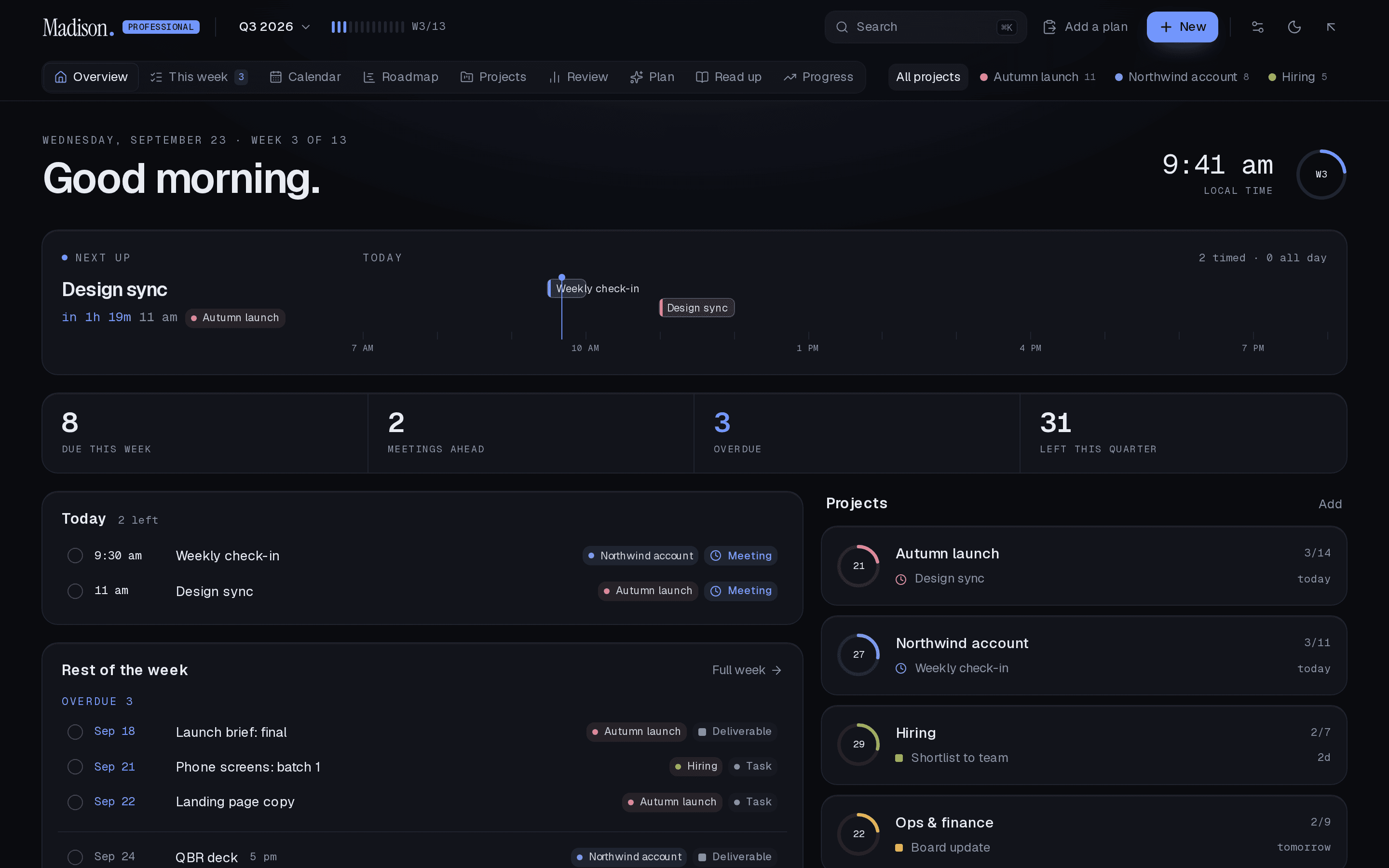
Overview, this week, calendar, roadmap, projects and review: the same items, drawn six ways, one click apart. Pick one.
A meeting is not a deadline and a milestone is not a deliverable. Madison draws each one differently, everywhere it draws them, so a quarter can be read at a glance instead of decoded.
A piece of work with a day on it. The bulk of any quarter.
Has an hour and a length, so the calendar draws it at its real size instead of as a dot.
A date somebody else is counting on. Hollow: it outranks everything beside it.
The thing that actually gets handed over. Haloed, because it is the point of the lane.
A marker on the roadmap rather than a piece of work. It is either reached or it is not.
The reader below is the real one, running in your browser. Pick a document and watch it find every date.
Three pieces of the planner, running on this page with the planner's own code. Type into them.
Read as the date: 5pmfri → Fri, Oct 16
The title field reads days, dates and times out of what you type and leaves the rest as the name. Try anything.
10 items across about 10 weeks · Kickoff, brief, freeze, launch day, retro. The classic arc of a quarter.
A launch, a client, a hiring round or an ops cycle, with the dates already spaced across the quarter. Pick one and the list is the one the planner would make.
8 due this week.
Phone screens: batch 1 (Hiring), Landing page copy (Autumn launch), Design sync (Autumn launch), Weekly check-in (Northwind account), and 4 more
Anything that is arithmetic over what is already on the page is answered at once, offline. Anything that is not, the planner offers to ask Claude.
Anything overdue first, with a way out. Then the week, day by day, every project at once, each meeting at its hour.
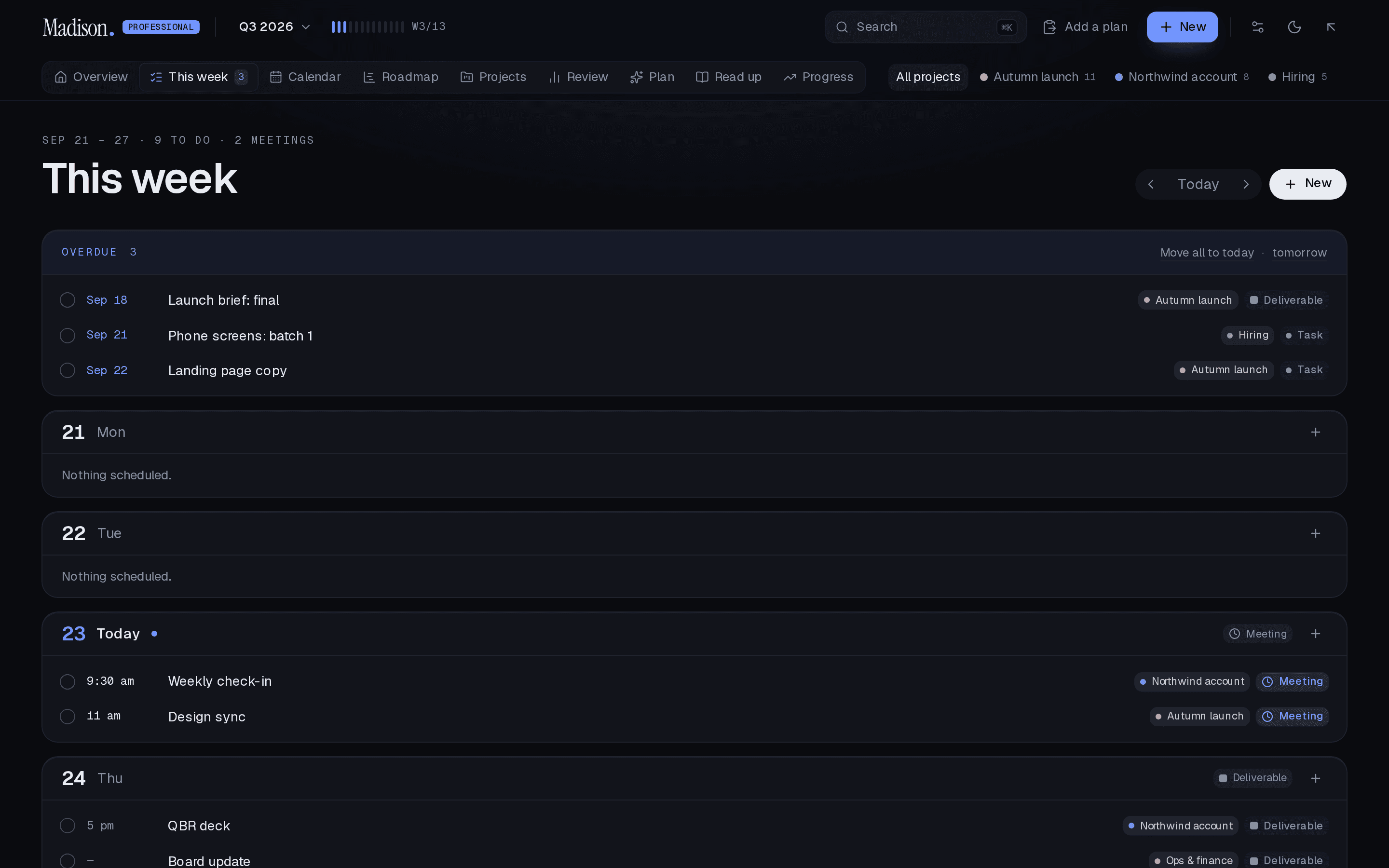
Anything late comes first and can be moved to today or tomorrow in one click. Then the days in order.
A meeting shows its time; a deadline shows its day. Nothing to open to find out when.
Which project, and whether it is a task, a meeting, a deadline, a deliverable or a milestone, at a glance.
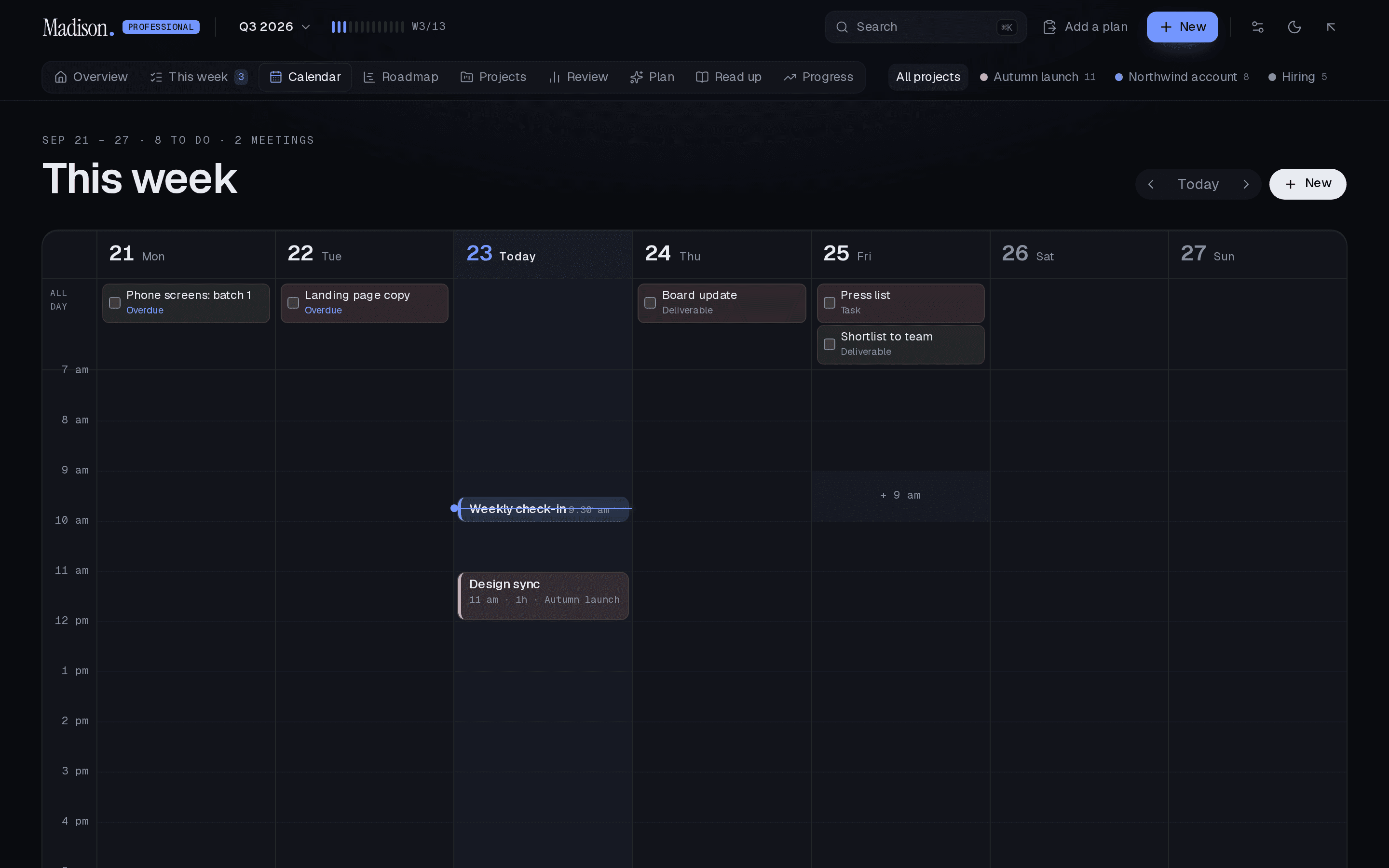
Seven days over a time axis. A meeting sits at its hour and takes its length; a deadline sits on its day. Drag either to reschedule it.
Half an hour is half an hour on the page, so a day full of them looks full before it is.
Pick a meeting up and drop it on Thursday. Repeats move one occurrence at a time.
Weekly or every two weeks, each occurrence its own row, so one can move without the rest.
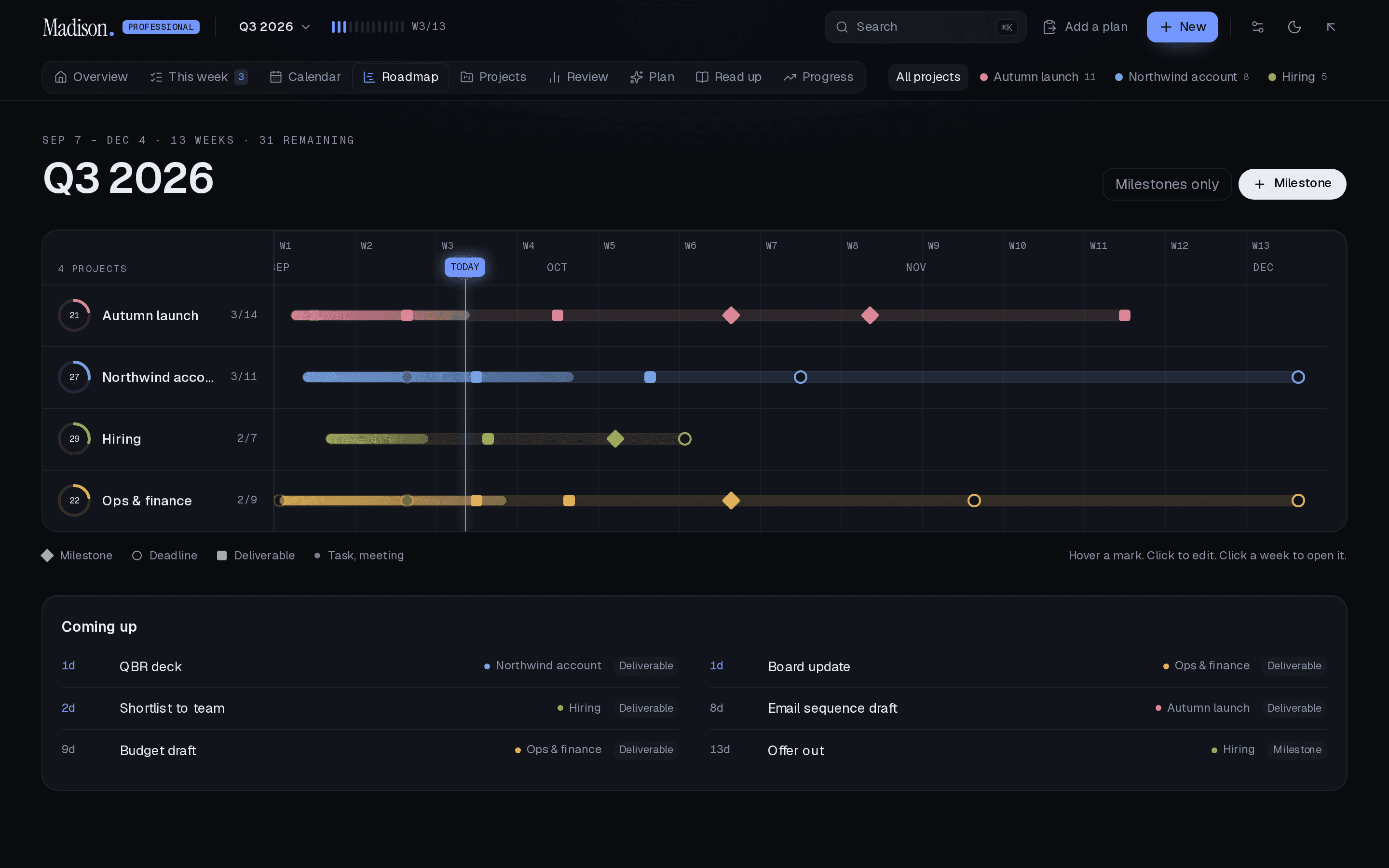
One lane per project, filling as work is done, with milestones, deadlines and deliverables in place and one line for today across all of them.
Hollow, so they outrank everything beside them. Milestones and deliverables are haloed.
Across every project at once, so the shape of the next month is one glance.
Any week number on the roadmap opens that week in the calendar, every project at once.
Everything below is in the demo, unlocked, without an account.
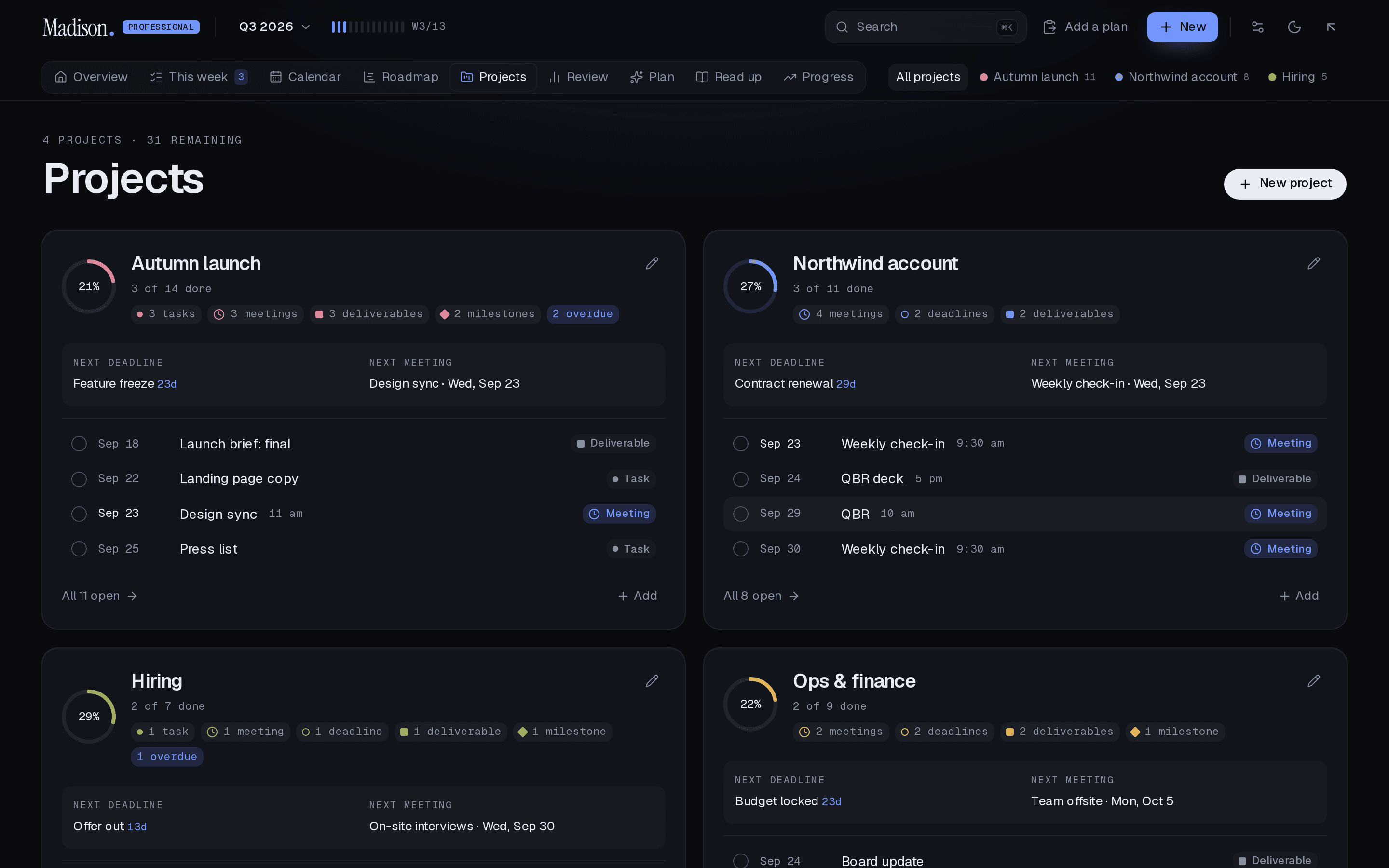
How far along, what is overdue, the next deadline and the next meeting — one card per project, and the open items under it.
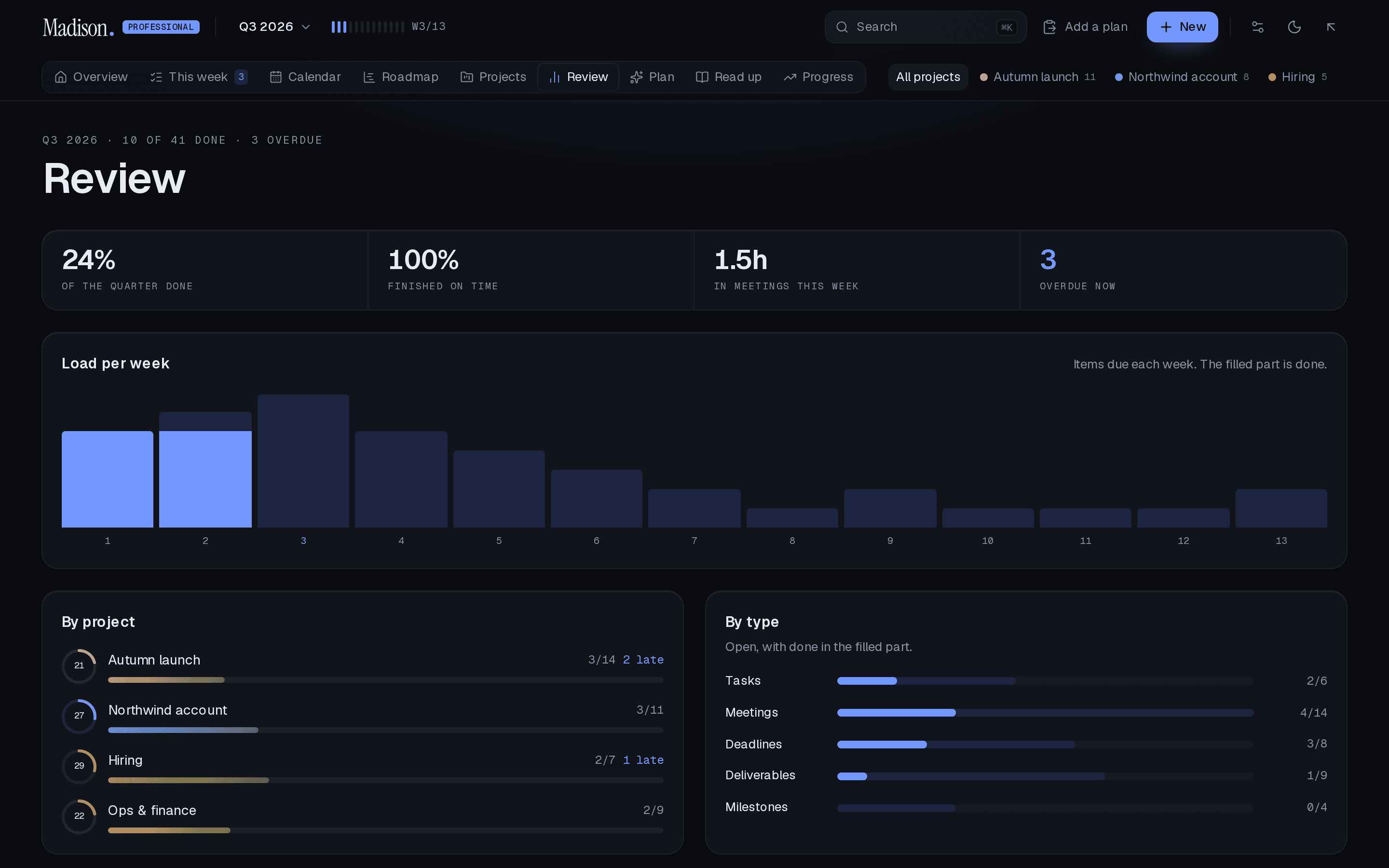
How much of the quarter is done, what finished on time, hours in meetings, and the load per week with the done part filled in.
One bar for every command: new item, add a plan, a template, export, and a question for Madison when none of those fit.
Weekly or every two weeks until a date. Each occurrence is its own row, so one can move without touching the rest.
A fresh quarter has shape in one click: a launch, a client, a hiring round or an ops cycle, with the dates already spaced.
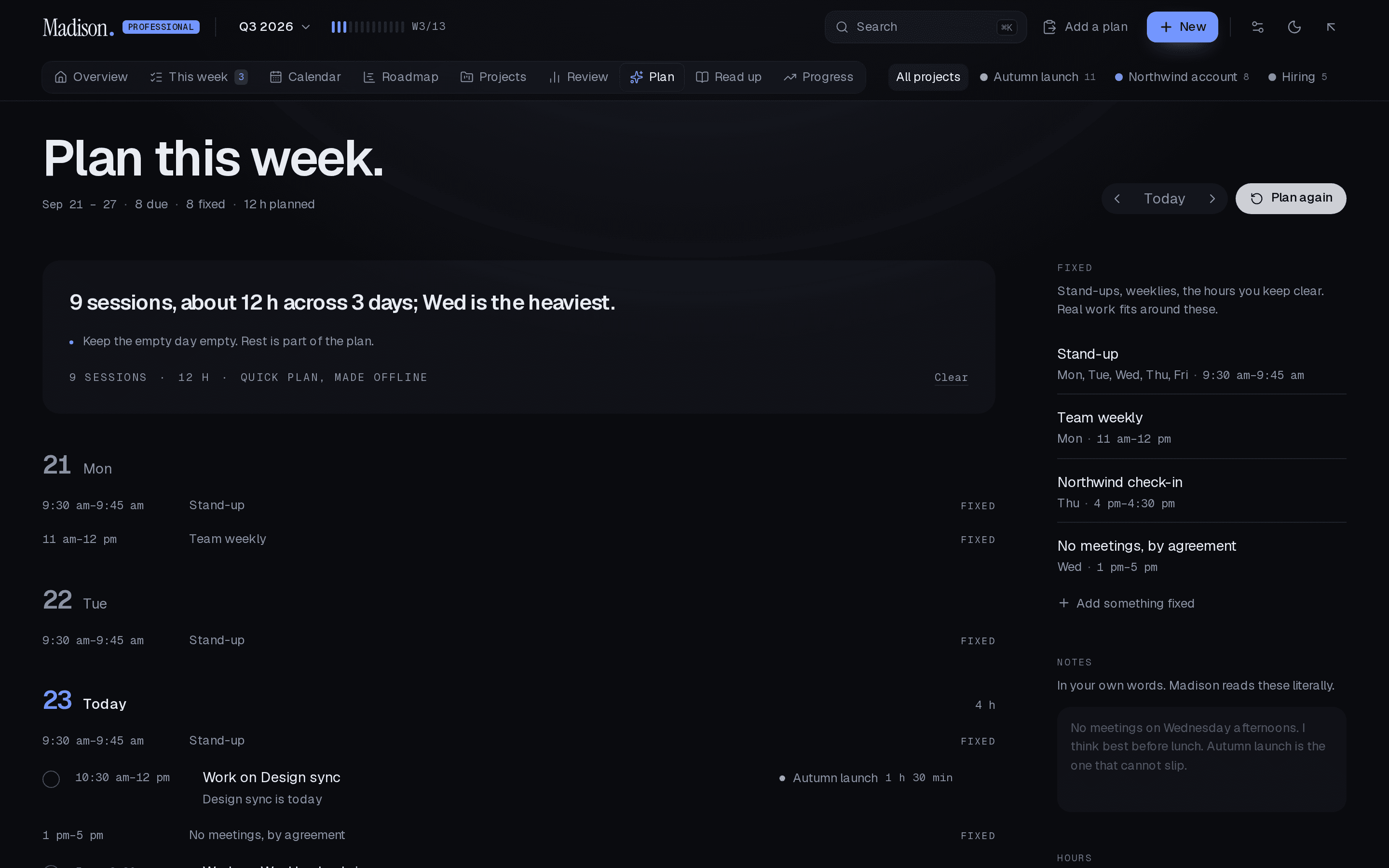
Stand-ups and weeklies first, then real work in the hours that are left, with a sentence saying why it chose what it chose.
A live calendar feed for Google, Apple or Outlook, a JSON backup of everything, or the printed page. What you put in comes back out.
Every one of these is real. Press a key now and watch it go down.
Six shapes of a term, each one something the planner actually draws.
Kickoff, brief, freeze, launch day, retro. One lane on the roadmap, every date on it.
The weekly check-in as a repeat, the QBR at its hour, the renewal hollow on the strip.
Screens, on-sites, the offer, the start date: eight weeks that have to happen in order.
Expense deadlines, the close, the board update, the budget locked by a date.
Stand-ups and weeklies first, then the real work in the hours that are left.
Filter to one with a click, or see all three lanes side by side with one line for today.
Anything not here, write to us. There is an address in the footer and a person reads it.
PDF, Word (.docx), OpenDocument (.odt), plain text, Markdown, CSV or HTML — or just paste. The text is pulled out on your device. Scanned PDFs with no text layer are not readable yet.
Claude reads the text and returns exact names and resolved dates. Only the text you drop in is sent, and only to be read; nothing about it is kept. If the reader is unavailable a rules-based one runs on your device instead, and the review step says which one ran.
It sits beside it. Madison is the page you plan on; subscribe to the live calendar feed and the dates appear in Google, Apple or Outlook next to everything else.
Choose weekly or every two weeks and an end date. Each occurrence is its own row, so you can move or skip one without touching the rest.
A free one. Sign up with an email and a password and your plan is kept in your account, so it is there on your laptop, your phone and anywhere else you log in.
Into your account, and nowhere else. It is stored under your own login and shown only to you. Export a JSON backup any time, or a calendar file (.ics) to see the dates in Google, Apple or Outlook.
Nothing. Madison is free while it is being built, and this copy cannot take a card even if you wanted it to. The prices on the pricing page are what it will cost when it is finished.
Drop in the document you already have. It takes about a minute, and you can see the whole thing before you sign up for anything.
No card to start. Export any time.